Cinched, Not Altered: The Vintage Belt That Rebuilds a Winter Coat
There is a particular moment in late November when a coat stops being an accessory and becomes infrastructure. You need it for the bus stop, the school run, the trudge from the station. And yet the coat doing all that work can still look like a grey felt sack with sleeves. That is where a vintage waist belt earns its place. Not as a trend, not as a costume, but as a small piece of engineering that gives shape to what you already own.
The beauty of a waist-tie is that it asks nothing permanent of your coat. No tailor, no darts, no taking in the sides and hoping for the best. You fasten a belt over the outside, adjust it to the day's layers, and undo the whole thing when the mood changes. For a 2026 British winter — one that still cannot decide between drizzle, frost and a mild Thursday — that flexibility is worth more than another coat.
Why a belt works when tailoring feels like too much
A winter coat is often cut generously so it can sit over a jumper. That generosity is useful in January and slightly defeating in the mirror. A belt at the waist creates a visual break, pulls the eye inward and makes the whole silhouette look deliberate. It can also solve the specific problem of a longline coat that swamps a shorter frame, or a bulky knit that makes a cardigan look like a duvet.
The trick is not to pull tight. A waist belt should suggest a waist, not tourniquet one. If you can slide a hand under the belt and the coat fabric does not bunch into a fan, you have probably got it about right. Over a heavy coat, a wider belt usually behaves better than a skinny one because it has more surface area to grip the fabric.
Three vintage shapes, three different jobs
The slim patent belt is the neatest option. A 1960s patent or mock-patent number, perhaps an inch wide, gives a crisp finish to a wool coat without adding bulk. It works best over smooth fabrics and smarter coats, and it looks particularly good in black, oxblood or deep navy. Check that the patent has not gone tacky or cracked; old patent can look fine on the shelf and then split at the buckle after one cold morning.
A medium-width leather belt is the everyday workhorse. Think 1970s or 1980s, two to three inches wide, with a simple buckle or a covered buckle. This is the one for charity-shop coats, tweed, corduroy and long cardigans. It can take a bit of weight and it does not demand a formal outfit.
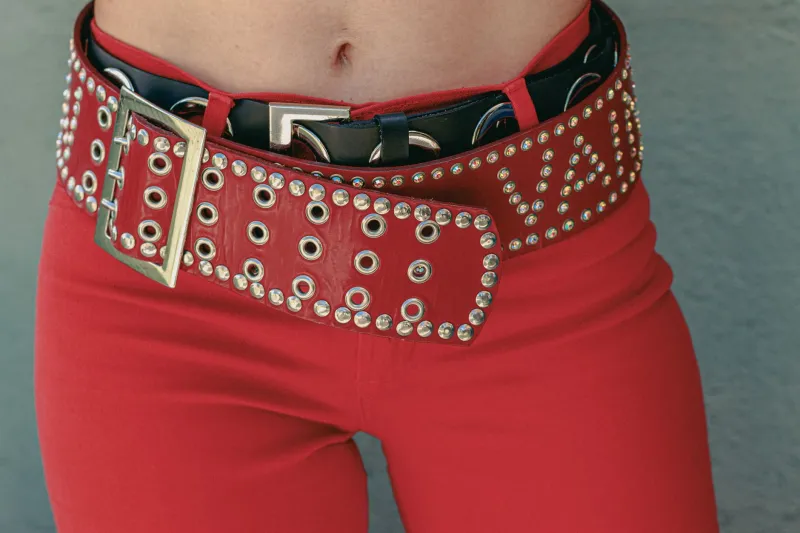
The wide 1980s cinch is the statement. Four inches or more, often with a shaped waistband or a dramatic buckle, it can transform a plain overcoat into something with a bit of swagger. It is also the easiest to get wrong: too wide, too stiff or too tight and you will feel every bus journey. Try before you buy, and sit down in it if the seller will let you.
The UK sourcing map: charity shops, fairs and car boots
Vintage belts turn up in the usual places. Charity shops are good for one-off leather belts at low prices, especially in towns with older populations and house clearances. Look in the basket by the till rather than the jewellery case; belts are often treated as accessories of little consequence and priced accordingly. Car-boot sales are excellent in spring and early autumn for wide leather belts, though you may have to buy a bundle to get the one you want.
Vintage fairs — the affordable ones held in church halls, town halls and football club function rooms — are better for checking condition and asking questions. Judy's Affordable Vintage Fair and similar regional events often have stalls with boxes of belts, and sellers usually know whether a buckle is original. If you are in London, Portobello and Spitalfields can still deliver, but go early and expect to pay for the privilege.
Measure before you go. A belt that fits over a dress will not necessarily fit over a coat. Take a fabric tape measure and note the circumference of your most-used coat at the waist, then add a couple of inches for layers. If you are buying online, ask for the measurement from the buckle to the middle hole, not the total length.
The brittle leather test
Old leather can look gorgeous and still be ready to snap. Before you hand over money, bend the belt gently at the middle. It should flex like a thick ribbon, not crack like a dry leaf. Look for fine crazing along the edges and around the holes; a little surface patina is fine, but deep cracks mean the fibres are gone. Check the back of the belt too, especially where it has been stored folded. A permanent crease is not fatal, but a white, dry crease is a warning.
Smell matters as well. Leather should smell faintly of hide, not of damp cupboard or old cigarettes. If it smells musty, it may clean up, but it may also be holding moisture that will shorten its life. Suede belts are trickier: brush them gently and avoid anything that will flatten the nap.
Hardware: the small bits that ruin the whole thing
A beautiful belt with a broken buckle is a project, not a bargain. Check the prong or pin — the bit that goes through the hole — for wobble. Make sure the buckle is not bent out of shape. On covered buckles, check that the fabric is not lifting at the corners. Eyelets should be secure, not spinning in the leather. Rivets should sit flush. If the belt has a chain or a decorative clasp, give it a tug; old metal can fatigue.
Replacing hardware is possible, but it changes the character of the piece and can cost more than the belt. If you love the leather and the buckle is sound, buy it. If the buckle is the only good thing, walk away unless you are handy with a screwdriver and a rivet set.
Wearing it over modern coats, knits and dresses
The simplest move is the coat belt. Put on your coat, then fasten the belt over the outside at your natural waist or slightly above. If the coat has a centre vent, check that the belt does not pull it open at the back. A belt over a double-breasted coat can look bulky; try a slimmer belt or place it lower, nearer the hips, for a looser feel.
With a bulky knit, belt the cardigan rather than the jumper. A longline cardigan belted over a fine knit and a pair of wide trousers is a good weekend uniform. Avoid belting a chunky jumper directly unless the belt is wide and soft; otherwise you will create a shelf of wool that refuses to sit down.
Over a dress, a vintage belt can make a summer frock work for winter. Choose a leather belt rather than patent, add tights and boots, and keep the belt at the waist rather than under the bust. If the dress is very full, a wide belt will anchor it; if it is slim, a narrow belt will do the job without interrupting the line.
The comfort check
A winter belt has to survive real life: sitting on the bus, reaching for the top shelf, eating a large Sunday lunch. Fasten it, then sit down. If it digs in or rides up, loosen it a hole. If the belt has only three holes and none of them work, it is not the right belt. A good cobbler can add holes, but only if there is enough leather beyond the last one.
Finally, store belts rolled rather than folded. Hang them from a thick hanger or keep them in a drawer with a little breathing room. A vintage belt that is looked after will outlast the coat it was bought for — and in 2026, that is a quietly satisfying thing to own.