Brim, Block and Britain: One Vintage Hat for Every Sky the Year Sends
Walk into any decent antiques centre in this country and there is usually a shelf near the back with four or five hats on it, priced at less than a round of drinks. For a lot of people that shelf is a novelty. For anyone who has worked out that a hat can rescue an outfit in about four seconds, it is the best-value rail in the building.
A hat does more than keep the rain off. It changes the outline of a person. It draws the eye upward, it frames the face, and on a grey February morning it can be the only bit of the outfit anyone notices. Vintage ones have the advantage of proper blocking, real felt, and a bit of history. They also have forty or fifty years of other people's heads to contend with, which is why you need to look inside before you look in the mirror.
What the Inside Tells You
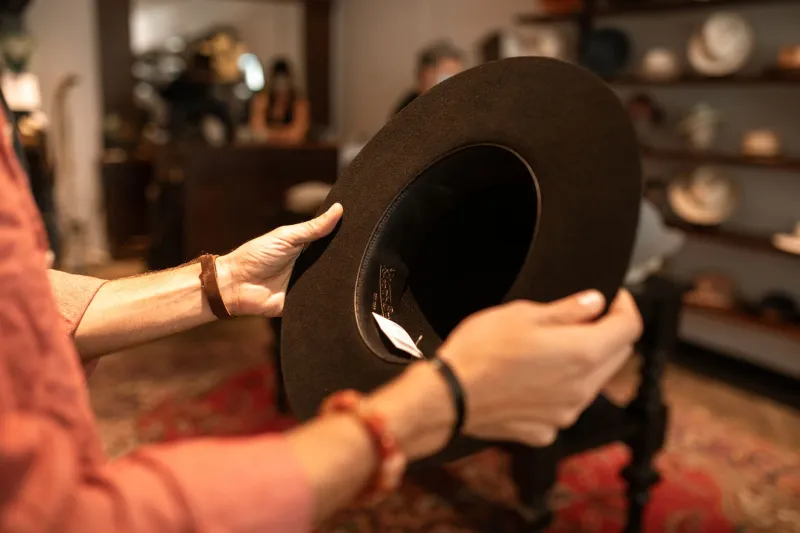
Turn the hat upside down first. The lining and sweatband are where the truth lives.
A fabric label stitched behind the sweatband is a good sign — it suggests the hat was made properly rather than run up in a mill somewhere with no name. Look for the size, usually in centimetres on British and European hats (57, 58, 59) and in inches on older American ones. If the sweatband is cracked, flaking, or hanging loose at the front, that is not a dealbreaker. A milliner can replace a sweatband for somewhere between £20 and £40, and it makes an old hat wearable again. If the sweatband smells of old cigarettes and damp cellar, that is often fixable too — a spell in a bag with bicarbonate of soda, then fresh air, does a surprising amount.
Check the crown for moth. Small holes in felt can be darned invisibly or, at a push, hidden under a hat pin or a band. Holes in the crease of a fedora are more tiresome because the crease bends and opens them up again. Look at the brim edge: a raw, fraying edge on tweed or wool is normal wear, but check that the brim itself is not warped. Hold the hat at eye level and sight along the brim. If it ripples like a potato crisp, it needs blocking, which is a job for someone with a wooden hat block rather than a kettle and optimism.
Finally, check the reed — the stiffened band inside the crown that gives the hat its shape. If it is broken, the hat will collapse. Some are replaceable. Some are not.
Proportion Is the Whole Game
The reason vintage hats can look costumey is almost never the hat. It is the proportion against the rest of the person.
A wide brim needs room underneath it. If you are small and fine-boned, a brim that extends past your shoulders will wear you rather than the other way round. A narrow brim, a cloche, a beret or a small pillbox will sit better. If you are tall or broad-shouldered, a wider brim and a taller crown balance the frame instead of disappearing into it.
Crown height matters as much as width. A tall crown lengthens the face; a low crown broadens it. There are no rules, only consequences. Stand in front of a mirror in decent light, put the hat on, and look at the gap between the brim and your eyebrows. If you cannot see your eyebrows at all, the hat is sitting too low. If there is a hand's width of forehead showing, it is perched. Somewhere in between is where most people look like themselves.
Measure your head with a soft tape around the widest part, just above the ears. Most British women sit around 56–57cm and most men around 58–59cm, but vintage hats often run small because heads, diets and hat-wearing habits were different. A felt hat can usually be stretched one size by a professional. A straw hat cannot.
Seven Moves for 2026
1. Felt fedora, chore jacket, straight jeans
The fedora stopped being a costume the moment people stopped wearing it with suits. Try a soft, fur-felt fedora in charcoal or dark brown with a canvas chore jacket, a plain tee and straight-leg jeans. The hat reads as practical rather than theatrical, and the whole thing costs less than a new coat.
2. Wool beret, worn off-centre, over a vintage overcoat
A beret worn dead centre on a round face can look like a tea cosy. Slide it a couple of inches to one side and pull it back off the forehead. With a proper wool overcoat and a scarf, it looks French in the useful way rather than the fancy-dress way.
3. Tweed bucket or rain hat, with a raincoat
A soft tweed hat with a stitched-down brim is the unsung hero of a British November. It sheds a shower, it does not blow off in a gale, and it looks better creased. Pair it with a mac in a contrasting tone — olive with oatmeal, navy with grey — and let the textures do the work.
4. Pillbox, with knitwear instead of occasionwear
A 1960s pillbox is the most misused hat in the charity shop. Worn with a matching dress and gloves it looks like a wedding guest from 1964. Worn with a chunky crewneck, straight trousers and a plain coat, it looks like a decision. Keep the rest of the outfit quiet and let the hat be the one formal thing.
5. Cloche, with a modern leather jacket
A 1920s-style cloche pulls low over the brow and suits almost nobody in the way it was originally worn. Sit it further back, show some hair, and put it with a boxy leather jacket and boots. The contrast between the soft felt and the hard jacket is what stops it feeling like a period drama.
6. Newsboy cap, with tailoring
A wool newsboy or baker boy cap is the easiest vintage hat for anyone who feels silly in a brim. It works with an overcoat, it works with a blazer, and it works with a plain jumper and jeans. Buy one in a colour you already wear — grey, brown, navy — and it will earn its keep from October to March.
7. Summer straw, with linen and nothing else
For the six or seven genuinely warm weeks we get, a vintage straw hat with a moderate brim is the best thing in the wardrobe. Keep the outfit underneath it simple — linen shirt, cotton trousers, sandals — and resist the urge to add a ribbon that matches. A faded original band is usually better than a new one.
A Word on Storage
Hang hats on a peg or rest them upside down on their crowns, never on the brim. Keep them out of direct sun and away from radiators, which dry felt out until it cracks. If a hat gets soaked, let it dry slowly at room temperature, packed with tissue paper to hold the shape, and resist the urge to sit it on a radiator.
And if you find one that fits and feels right, buy it. Good vintage hats are still cheap because most people have not worked out what they are for. That will not last forever.