The Scarf That Does the Work: Nine Vintage Neck Moves for 2026
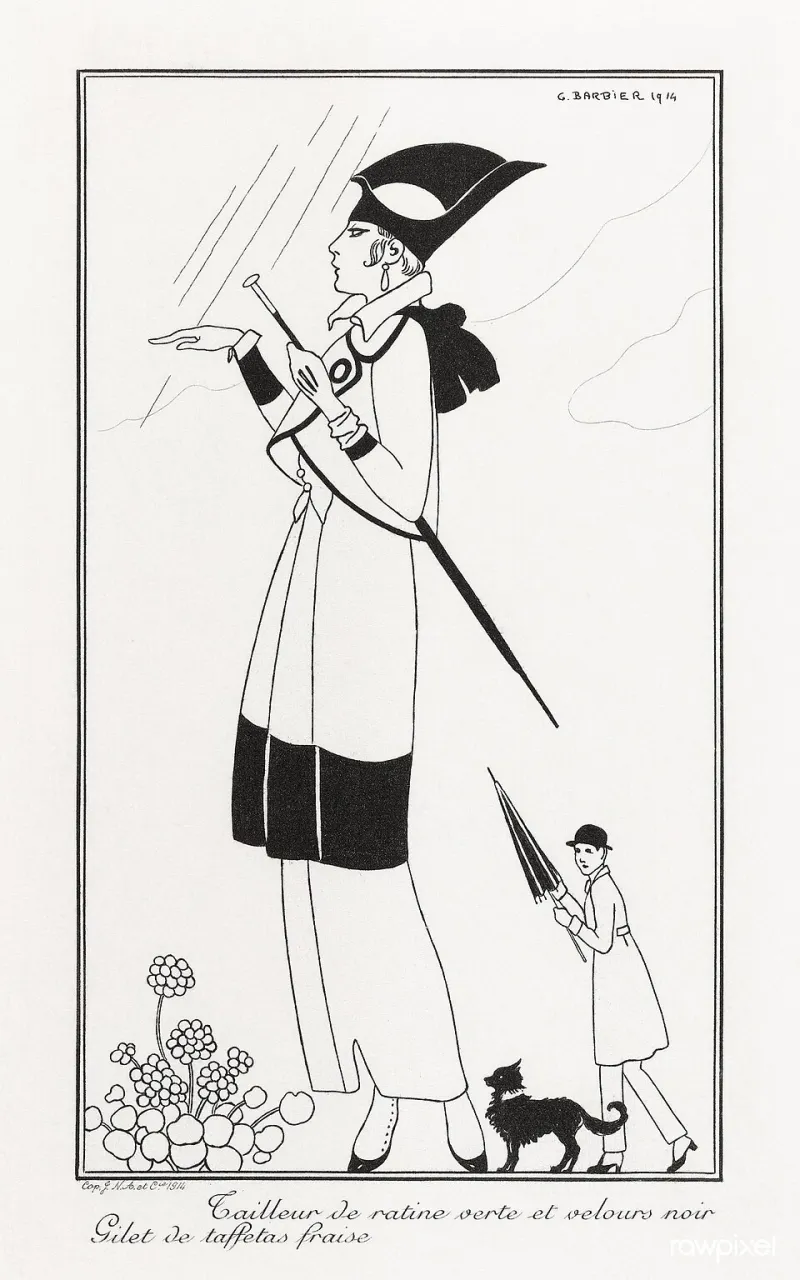
Photo: Free Public Domain Illustrations by rawpixel, CC BY 2.0, via Wikimedia Commons
There is a particular British morning in November: grey light, a dampness that finds your collar, and a coat that suddenly feels like the dullest thing you own. This is where the vintage scarf earns its keep. Not as a decorative afterthought, but as the one piece that changes the register of an outfit before you have finished your first coffee. A square of silk picked up for the price of a sandwich can make a wool coat look considered and a plain blazer look as though it has a personality.
The appeal is partly practical. Scarves are cheap to buy, easy to store and forgiving of size. They also carry the fingerprints of their era more clearly than almost anything else: the acid-bright geometry of the 1970s, the confident swirls of the 1980s, the neat little florals of the 1960s. In 2026, when so much new clothing is anonymous, that small hit of pattern and history goes a long way.
The two-minute fibre check
Most vintage scarves in charity shops fall into two camps: silk and polyester. Both can be lovely, but they behave differently at the neck. Silk has a dry, cool handle. Scrunch it gently in your hand and it should soften and spring back rather than feeling slick or stiff. Hold it up: good silk drapes in fluid folds and catches the light without shining like a ribbon. Polyester is springier, sometimes slightly clammy, and it tends to hold a crease where silk would relax. A 1970s polyester square can be a brilliant thing, especially for rain and wind, but it will not knot with the same elegance.
Look at the edges. A hand-rolled and hand-stitched hem, where the tiny stitches are slightly irregular and the roll is soft, is a sign of quality. A machine overlocked edge is not a disaster, but it usually points to a cheaper, later piece. Turn the scarf over and check the corners, where wear shows first. Small pulls are fine; a frayed centre or a watermark that has gone brown is not.
Labels are worth a look, too. Liberty, Jacqmar, Richard Allan and the great French houses turn up more often than you might think, but so do excellent department-store scarves from British shops that no longer exist. A care label that says dry clean only is a useful hint about fibre, though not a guarantee.
Nine moves worth knowing
1. The two-finger neckerchief. Take a small square, fold it into a triangle, then roll from the long edge towards the point. Wrap it once around your neck, tie a single loose knot at the front and tuck the ends under a shirt collar. It works with a crew-neck knit or a plain white tee under a coat.
2. The collar bandana. Fold a medium square into a triangle and roll it into a band. Lay it flat under the collar of a trench or a waxed jacket, with the point at the back, and tie the ends loosely at the front. It keeps the wind off your throat without the bulk of a wool scarf.
3. The wet-morning headscarf. This is the 1960s move that still makes sense in a British drizzle. Fold a large square into a triangle, place the flat edge across your forehead and tie the ends at the nape, tucking the point under. It keeps your hair dry on the school run and looks deliberately film-star-ish in a way a hood never will.
4. The ascot tuck. Use a long oblong scarf, fold it in half lengthwise, drape it round your neck and pass the ends through the loop. Pull it snug, then tuck the ends into the V of a shirt or a fine-knit jumper. It is warmer than it looks and neat enough for the office.
5. The belted sash. A long silk or polyester oblong threaded through the belt loops of jeans, or tied over the belt of a trench coat, adds colour at the waist without buying a new belt. Keep the knot to one side and let the ends hang.
6. The bag-handle wrap. Wind a narrow scarf tightly around a tired leather handle, tucking the ends in at the inside edge. It covers scuffs, protects the leather from hand cream and gives an old bag a new accent for very little money.
7. The blazer cravat. Fold a square into a narrow band, place it inside the lapels of a blazer so that a flash of pattern sits at the neck, and tie it at the back. This is the easiest way to make a charity-shop jacket look intentional.
8. The turban twist. For windy days and bad hair, fold a large square into a band, place it at the hairline, cross the ends at the back, bring them forward and knot them on top. It stays put and looks more considered than a beanie.
9. The wrist or hair tie. A small square folded into a narrow band makes a good bracelet over a shirt cuff, or a ribbon for a ponytail. It is the least serious use of a scarf, and often the one that gets the most compliments.
Keeping it nice
Most vintage silk will survive a gentle hand wash in cool water with a drop of mild shampoo. Rinse well, roll in a towel to remove the worst of the water, then dry flat away from radiators. Iron on the silk setting, on the reverse, while the scarf is still slightly damp. Store folded rather than hung, and keep lavender or cedar nearby. Polyester is easier: cool wash, hang to dry, and a low iron if needed.
A good scarf does not need to be precious. It needs to be worn, knotted, stuffed into a coat pocket and pulled out again. That is how it earns its place in a 2026 wardrobe: not as a museum piece, but as the cheapest way to make the clothes you already own feel like a decision.