Tiny Clues: Reading Vintage Buttons, Rescuing Good Clothes and Styling Them in 2026
A button is often the first thing your hand finds on a vintage coat, and the last thing anyone thinks to examine. That is a mistake. Buttons are tiny, tactile clues: they can point to a garment’s age, hint at its original price, reveal an old repair, or explain why a decent piece is sitting unloved on a charity-shop rail. They are also one of the easiest ways to refresh modern clothes without buying new ones. Think of them as the jewellery a garment wears every day.
The button as a date stamp
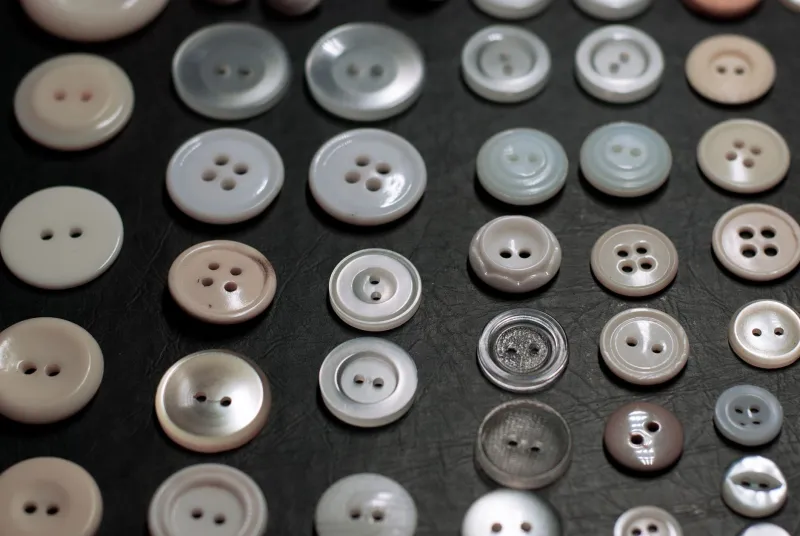
Start with material. Horn buttons feel warm, look slightly uneven and often show faint striations rather than a printed pattern. Mother-of-pearl has a cool, soapy weight and a flicker of colour that shifts in the light; it was common on everything from blouses to evening coats. Early plastics are where things get interesting. Celluloid, Bakelite and casein were used from the late nineteenth century onwards and can mimic ivory, tortoiseshell or jet. They tend to feel lighter than horn, sound sharper when tapped and may show a seam or mould line. Acrylic buttons from the later twentieth century are usually brighter, more uniform and less forgiving of heat.
Construction matters too. Four-hole buttons are the workhorses; two-hole buttons can feel older or more formal; shank buttons sit proud of the fabric and suit heavier coats. A backmark can be a gift. British uniform buttons often carry maker names, regimental details or city marks, and they are a reliable reminder that a button may have had a previous life entirely. None of this is a perfect science. Buttons were replaced, swapped and upgraded, so read them as evidence rather than a certificate.
What replacements tell you
A mismatched button is not automatically a disaster. Look at the thread first: if one button is sewn on in a different shade or with a different stitch pattern, it has probably been replaced. Check the wear ring around the buttonhole. A smaller or larger ring than the rest of the set suggests a change in size. Enlarged holes, flattened thread and a slightly different shank length all point to later repairs. A set of five matching buttons with one odd interloper is common, and it usually means the garment was worn, mended and kept going.
That is useful at the till. A missing button should affect the price, not necessarily your decision. If the buttons are otherwise good, a replacement can be found. If the set is already inconsistent and the fabric is tired, walk away. The trick is to decide whether the buttons are part of the garment’s character or simply a problem you are about to inherit.
Rescuing a promising piece
When you find a good coat or cardigan with tired buttons, keep the originals in a small envelope before you change anything. Future you may want them, and a buyer certainly will. Then match weight and scale. A winter coat usually wants 25mm to 30mm horn or horn-look buttons; a cardigan sits comfortably at 15mm to 18mm; a blouse needs something smaller and lighter, around 10mm to 12mm. Too small looks mean, too large looks borrowed from a different garment.
Sew with doubled thread and leave a small thread shank on thicker fabrics so the button sits above the cloth. Do not soak horn or mother-of-pearl buttons, and be careful with older plastics, which can discolour or crack. A wipe with a barely damp cloth is usually enough. If you are swapping buttons on a modern coat, keep the old ones in the pocket. It is a small ritual, but it means the change is reversible.
Where to find singles and sets in 2026
Charity shops remain the best starting point. Ask behind the counter whether they keep a button tin; many do, and it is often priced by the handful rather than the piece. Antique fairs and car-boot sales are better for sets and cards of deadstock. Kempton Park, Ardingly, Newark and Sunbury are all worth a rummage if you are nearby, while local haberdashery stalls often have boxes of unsorted buttons that reward patience. Militaria stalls are excellent for British uniform buttons, though buy because you like the look rather than because you think it is an investment.
Online lots can be brilliant if you are willing to sort through mixed bags. Look for full sets on original cards, check for chips and cracks, and ask about missing shanks. If you only need one button, buy two. The spare will justify itself eventually.
Wearing statement buttons without costume
A strong button should look like a decision, not a costume. Keep the rest of the outfit quiet. Replace the plain plastic buttons on a modern wool coat with a set of mottled horn or dark mother-of-pearl, and let that be the focal point. A navy cardigan with pearl buttons and jeans is charming; the same cardigan with pearl buttons, a cameo brooch and a full vintage outfit can start to feel like fancy dress. Pick one era signal and stop there.
Scale is everything. Tiny glass buttons on a heavy coat look lost; big horn buttons on a silk blouse look clumsy. If you are using a single military button, treat it as jewellery: one on a plain tote, one at the cuff of a modern jacket, or one sewn onto a simple hair tie. It is a wink, not a uniform.
A button box is not clutter. It is a small archive of materials, repairs and near-misses, and it is one of the cheapest ways to make a modern wardrobe feel more considered in 2026. Next time a garment catches your eye, turn it over and look at the buttons. They usually have something to say.