The Unlabelled Dress Detective: Reading Seams, Zips and Fabric in 2026
There is a particular thrill in finding a dress with its label cut out. It feels anonymous, slightly mysterious and often a little cheaper than its labelled neighbour. But no label does not mean no clues. In 2026, with resale apps busier than ever and vintage fairs packed from Spitalfields to Glasgow, dating an unlabelled dress is part hand-feel, part detective work and part healthy scepticism. This guide is for UK shoppers who want to read the garment rather than trust the swing tag.
Start by turning it inside out
Before you fall for a print or a silhouette, look at the inside. Construction is usually more honest than styling. Check the seam allowances, the way the seams are finished, the facings at the neck, the interfacing behind a collar and the armhole finish. Look at the underarms for wear and the hem for alterations. A dress that has been let down, taken in or shortened can still be lovely, but those changes affect both date and value. If an online seller will not show you the inside, treat that as information in itself.
On the charity-shop rail
Charity shops are where unlabelled dresses most often surface, and they reward a calm, systematic eye. Take the dress to daylight if you can. Turn it inside out. Run the zip up and down. Look at the zip pull, the tape and the stitching around it. Check the hem: is it hand-stitched, machine-blind-stitched, pinked or simply turned and topstitched? Look at the side seams and the bust darts. A quick feel of the fabric will tell you more than a hundred hopeful thoughts about the print. And check the button backs and the inside of any pockets, where labels and maker's marks sometimes hide.
At the vintage fair
Fairs are better for asking questions, but the lighting can flatter. Use the daylight near a doorway if possible. Touch the fabric for weight and drape. A dress that feels thin and papery may be older than one that feels bouncy and synthetic, but not always. Ask the dealer what they know, then verify it yourself. Compare the dress with nearby pieces from the same rail. Look for repairs, underarm shields, let-out seams and replaced zips. A replaced zip is not a disaster, but it should be reflected in the price.
In online listings
Online buying is where unlabelled dresses can mislead most easily. Ask for clear photographs of the zip pull and zip tape, the care label if there is one, the inside hem, the side seam, the underarm area and the back neck facing. Ask for measurements rather than relying on a modern size. Ask whether the seller has altered it. Check the returns policy before you commit. On eBay, Vinted and Etsy, phrases such as 'vintage style' or 'retro look' are not the same as vintage. A reproduction can be charming, but it should not be priced as a 1950s original.
Fastenings: zips, buttons and hooks
Zips are one of the most useful dating tools, but they are not a simple calendar. Metal zips with cotton tape often point towards the 1930s to 1950s, yet modern metal zips exist and old zips were sometimes replaced. Look for branded pulls such as Lightning, Opti or YKK. Nylon coil zips became common from the 1960s onwards. Invisible zips are more usually a later feature, though they are not a guarantee. Buttons can be just as telling: early plastics, casein, metal shanks and hand-covered buttons all have their own feel. Hook-and-eye fastenings, press studs and Velcro all have histories, but Velcro on a dress usually suggests the 1970s or later.
Seams and hem finishes
Pinked seams were used in the 1930s and 1940s, but pinking shears never went away, so a pinked seam alone proves little. French seams suit fine fabrics and can be old or modern. Overlocked seams are common from the 1960s and 1970s onwards, but overlockers have been around longer than many shoppers assume. A hand-stitched hem can suggest age, but plenty of modern home sewers do beautiful hand finishing. A machine blind hem is a useful clue, often pointing to the 1950s or later. Bias-bound seam allowances are another good detail to note, especially on 1940s and 1950s garments.
Fabric composition without a label
You cannot do a burn test on the charity-shop rail, so learn by touch. Acetate lining feels cool and slippery; Bemberg lining feels smoother and more expensive. Viscose has a soft, slightly fluid hand. Courteille, Orlon and Terylene are names worth recognising from mid-century labels and adverts. Crimplene and polyester double knit have a springy, dense feel that shouts 1970s to many shoppers, though synthetic fabrics were used earlier too. Elastane in a dress usually points to the 1980s or later. Care labels became more common in the 1970s, but their absence does not automatically make a dress older.
Era-by-era tells
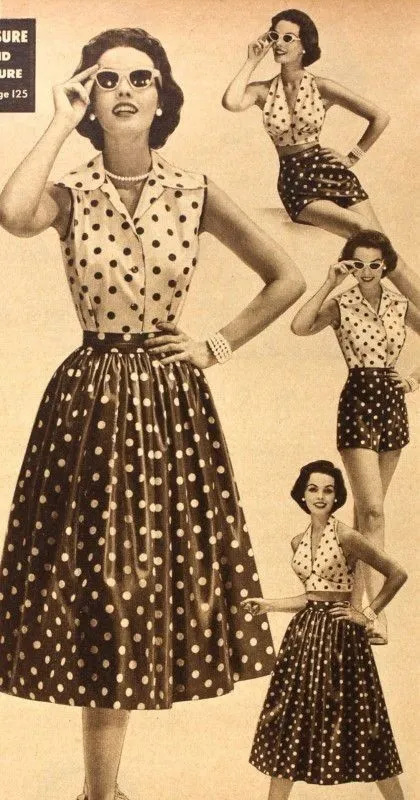
1930s and 1940s dresses often show metal zips, pinking, bias cutting and hand finishing. Wartime utility clothing can carry the CC41 mark, and rayon and wool crepe are common. 1950s dresses frequently have full skirts, metal zips, acetate linings, bound seams and very defined waists. 1960s pieces often bring nylon zips, A-line shapes, overlocking, polyester and bold prints. 1970s dresses are often Crimplene or double knit, with big collars, elastic waists and care labels. 1980s dresses frequently have shoulder pads, serged seams, YKK zips, metallic buttons and elastic waists. 1990s pieces can be minimally constructed, with viscose, elastane, Velcro and printed labels.
Common misreadings to avoid
A hand-stitched hem does not prove a dress is old. A metal zip does not make it 1940s. Overlocking does not automatically mean 1980s. A missing label does not mean homemade. A care label does not always mean 1970s, and a pinked seam does not always mean 1930s. Be wary of 'label ghosts', where a cut label has left a rectangle of unfaded fabric, and be equally wary of a dealer's confident date. The Woolmark, launched in 1964, is a useful clue but not a definitive one. British labels such as 'Made in England' can be genuine, but they are also reproduced.
A final ten-point check
Turn it inside out. Check the zip pull and tape. Read the seam finishes. Inspect the hem. Feel the fabric. Look under the arms. Check the button backs. Look for label ghosts and alterations. Consider the silhouette against the construction. And check the return policy before you buy online. Do that, and an unlabelled dress stops being a gamble and becomes a very good story.